Doctoral Thesis
A systemic analysis of social security litigation
Presentation of the thesis "Critical essay on the organisation of social security litigation"
A litigation system that wears disputes down
Despite numerous reforms, social security litigation still seems to be characterised more by the "exhaustion" of disputes than by their early resolution. This is evidenced by the appeal rates against decisions of the amicable appeal boards, the lengthy time to judgment, and the reversal rates on appeal and before the Court of Cassation.
Social security litigation therefore does not follow the dispute pyramid described by Miller and Sarat. These authors depict litigation as a succession of stages, with the parties' claims at the base and referral to a judge at the top. The pyramid should theoretically have a steep slope, reflecting the decreasing number of disputes at each stage.
Social security litigation resembles more a tunnel with a narrow entrance: once the appeal is initiated, the successive stages do not allow for sufficiently early resolution.
Dispute pyramid
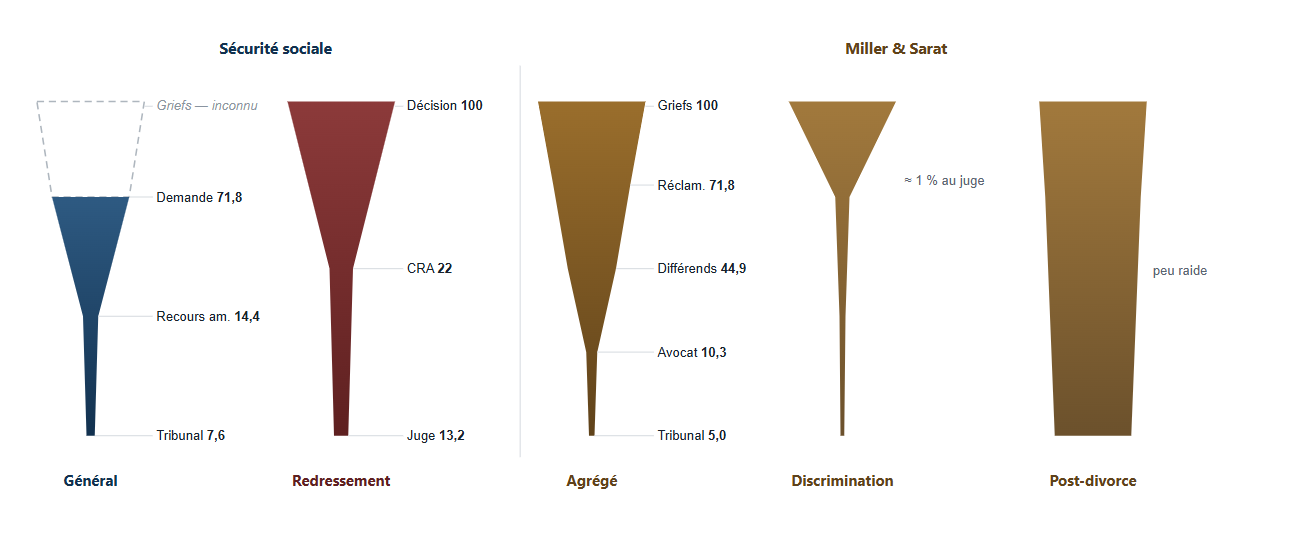
Illustration based on the data presented in the thesis.
This visual was created with the help of an artificial intelligence tool to facilitate understanding of the argument. It does not appear in the thesis and is not, in itself, a scientific result. The data, their sources and their methodology are set out in the manuscript.
Why this thesis?
The starting point of this research is my experience as Head of Litigation at URSSAF PACA. There, I served both as legal advisor to the various departments and as head of the litigation department.
I felt as though I were on a leaking ship, where the lawyers were bailing out water, when the priority should have been to fix the breach.
I then observed that disputes mostly originated from difficulties that had not been resolved upstream. It therefore seemed insufficient to solve problems one by one; their structural causes had to be identified. I thus chose to approach social security litigation as a system: a continuous chain that begins with the request addressed to the agency and ends, where applicable, with the judge's decision.
The thesis focuses on the common core of social security litigation, across all schemes. It examines, in its entirety, litigation primarily opposing a social security agency and an individual litigant. The aim is to identify, beyond isolated malfunctions, the design flaws liable to affect the system as a whole.
Dispute System Design
To carry out this analysis, I drew on the scholarship on Dispute System Design, or DSD, which I discovered during a stay in the United States.
Theorised in the 1990s, DSD studies the integrated sets of procedures and structures designed to prevent, manage and resolve the flow of disputes within an organisation or institution. It is a tool of litigation engineering: it is not concerned solely with the trial itself, but with the whole pathway that may lead a difficulty before a judge.
Its guiding principle is resolution at the earliest possible stage. The dispute should first be capable of being resolved between the parties, then, where necessary, with the involvement of a neutral third party, and, as a last resort, by an authority, most often a judicial one.
DSD also makes it possible to assess the quality of a litigation system. Such a system must be accessible, fair, transparent, stable and legitimate. It must inspire sufficient trust for its decisions to be understood and accepted, even when unfavourable.
The analysis thus takes into account the length and cost of proceedings, the recurrence of disputes, the quality and durability of solutions, their effects on the relationships between the parties involved, and their satisfaction. It makes it possible to identify flaws in detection, referral, procedure, competence or legitimacy.
As a specialist in social security law, I use this method to confront legal rules with the reality of administrative and judicial practice. DSD is thus the guiding thread of a study that views litigation not as a mere juxtaposition of procedures, but as a living system.
Does social security litigation make it possible to prevent disputes and resolve them as early as possible, or does it, on the contrary, make recourse to a judge almost inevitable?
Topics examined through the lens of DSD
This systemic approach is applied in particular:
The study thus seeks to determine how flaws emerge, are reinforced or recur at each stage, from the onset of the dispute to its judicial resolution.
What the thesis establishes
Social security litigation does not yet constitute a true dispute resolution system. Built through a succession of piecemeal reforms, it juxtaposes procedures without organising a coherent pathway for the prevention, handling and resolution of disputes.
Its failings are not isolated. They appear from the very request addressed to the agency, continue during the inspection and internal appeals stages, and reach the judge without having been corrected. Each stage thus tends to reproduce, and sometimes aggravate, the flaws of the previous one.
The research identifies the fragmentation of responsibilities and the lack of professionalisation as two major drivers of this functioning. It shows that an effective reform requires rethinking the litigation chain as a whole so that disputes can be resolved at the earliest possible stage.
Drawing on the principles of Dispute System Design, the thesis proposes a new procedural and institutional architecture for social security litigation. This reconstruction and the resulting proposals will be developed in the forthcoming book.